


Calculation of AgNOR Mean in Buccal Mucosa among Glue Abusers in Shendi Town-Sudan
- Faculty of Medical Laboratory Sciences, Shendi University-Sudan
- Ahfad University for Women
Abstract
Background: The glue is a complex mixture of chemicals that may lead to cellular proliferation. Detecting signs of cellular proliferation among glue abusers can serve as a warning to caregivers and concerned individuals. This study aimed to identify cytological changes in the buccal mucosa of glue abusers. Methods: This descriptive cross-sectional study included buccal smears collected from 150 glue abusers in Shendi City, Sudan. A buccal smear was taken from each participant, and the AgNOR mean was calculated for each smear. Results: Cytological screening revealed that all glue abusers showed an elevated average mean of AgNOR numbers. There was a strong statistical correlation between the AgNOR number and both the dose of glue and the frequency of glue intake per day. Conclusions: Cellular proliferation in the buccal mucosa of glue abusers was significantly higher than in non-glue abusers.
Introduction
Drug abuse causes different social, economic, and health problems such as intoxication, euphoria, hallucinations, depersonalization, derealization, dizziness, loss of motor coordination, and some sound distortion depending on the substance and the dose1. Inhalant users inhale vapor or aerosol propellant gases by using plastic bags held over the mouth or by breathing from a solvent-soaked rag or an open container. The practices are known colloquially as "sniffing," "huffing," or "bagging." Inhalants affect the brain2,3 and cause brain damage which can lead to death4.
As a probable result of glue abuse, cell proliferation occurs leading to an imbalance between proliferation and apoptosis5.
Methods
This was a descriptive cross-sectional study conducted in Shendi town during the period from June 2022 to March 2023. This study included 150 participants divided into 3 groups. Group one included 50 glue abusers as the case group, and the control group contained 100 participants, apparently healthy individuals further subdivided into two categories. Control group one included 50 participants similar to the cases in all features except that they were free of glue abuse, while control group two contained individuals free from glue abuse and tobacco. Buccal smear was taken from each participant by using a toothbrush to scrape cells from the oral mucosa, and the AgNOR mean was calculated in each smear. Questionnaire sheets were used to record all participant and sample data. The data was analyzed using the Statistical Package for Social Sciences (SPSS) version 21.0.
Argyrophilic Nucleolar Organizer Regions (AgNOR) Method
The air-dried smear was taken to DW, prepared silver-staining solution immediately by mixing two volumes of 50g silver dissolved in 100 ml DW with one volume of 2g gelatin dissolved in 100 ml DW and 1 ml formic acid. It was stained by the silver solution for 45 minutes and finally mounted in DPX.
Interpretation of Results
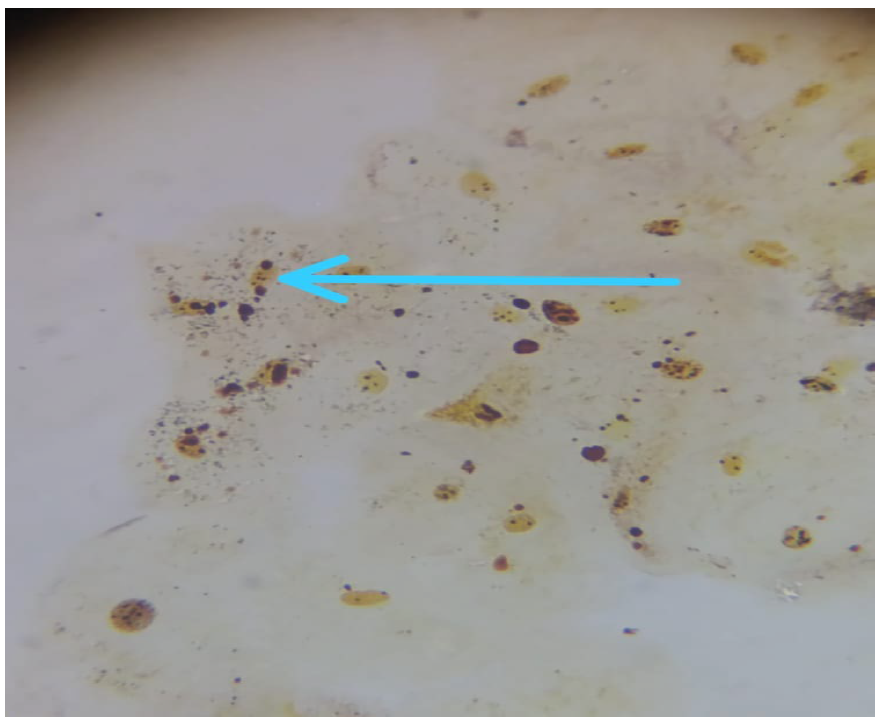
AgNOR count was carried out by counting the number of AgNOR dots in 100 nuclei using a microscope at 10x and 40x magnification. All smears screened horizontally from left to right and the AgNOR count in the nuclei of the first 50 non-overlapping, inner layers of nucleated epithelial cells. Superficial cells with pyknotic nuclei were not counted. The silver-stained nucleolar organized regions, visible as black or dark brown dots located within the nuclei of the cells, were counted; overlapped black dots were counted as one structure6,7,8.
Ethical Approval and Consent to Participate
Ethical approval was obtained from Shendi University Ethical Research Committee (No. SHE-RES/04-08-12, dated 8/1/2022) in accordance with the Declaration of Helsinki Principles. Approval was also obtained from Shendi hospital administration before sample and data collection.
Results
The age of glue abusers ranged from 6 to 21 years old with an average mean age of 14 years old.
In this study, we assessed the correlation of AgNOR number among study participants (case, control 1, and control 2). The boys who were in the case group showed that all of them (100%) are at risk of cancer (with an average NOR of more than 2), in control 1 showed that most of them (98%) are at risk of cancer (with an average NOR of more than 2), and in control 2 showed that only 2% of them are at risk of cancer. The P-value was 0.000 as indicated in (Table 1).
Regarding the correlation of AgNOR number with the dose of glue per day, our results revealed that all boys who used glue are at risk of cancer. The participants who took up glue less or equal to 4 times per day included 4 participants out of 50 within an average NOR of 1.6%. The participants who took up glue 5 to 10 times per day included 26 participants out of 50 within an average NOR of 17.3%. The participants who took up glue 11 to 15 times per day included 10 participants out of 50 within an average NOR of 6.7%, and the participants who took up glue 16 to 20 times per day included 10 participants out of 50 within an average NOR of 6.7%. The P-value was 0.000 as illustrated in (Table 2).
In the correlation of AgNOR with the duration of use among participants, we found that all boys are at risk of cancer, and 38 participants out of 50 had been glue abusers for less than or equal to 5 years, with an average NOR of 25.3%. The boys who had been glue abusers for 6 to 10 years were 10 boys with an average NOR of 6.7%, and only 2 participants had been glue abusers for 11 to 15 years with an average NOR of 1.3%. The P-value was 0.000, as shown in (Table 3).
Correlation of AgNOR number among study participants
| average of NOR | Total | P.V | ||||
|---|---|---|---|---|---|---|
| Less than 2- normal | more than 2 - risk of cancer | |||||
| Participant | Case | Count | 0 | 50 | 50 | 0.000 |
| % within participant | .0% | 100.0% | 100.0% | |||
| % within average of NOR | .0% | 49.5% | 33.3% | |||
| % of Total | .0% | 33.3% | 33.3% | |||
| Control 1 | Count | 1 | 49 | 50 | ||
| % within participant | 2.0% | 98.0% | 100.0% | |||
| % within average of NOR | 2.0% | 48.5% | 33.3% | |||
| % of Total | 0.7% | 32.7% | 33.3% | |||
| control 2 | Count | 48 | 2 | 50 | ||
| % within participant | 96.0% | 4.0% | 100.0% | |||
| % within average of NOR | 98.0% | 2.0% | 33.3% | |||
| % of Total | 32.0% | 1.3% | 33.3% | |||
| Total | Count | 49 | 101 | 150 | ||
| % within participant | 32.7% | 67.3% | 100.0% | |||
| % within average of NOR | 100.0% | 100.0% | 100.0% | |||
| % of Total | 32.7% | 67.3% | 100.0% | |||
Correlation of AgNOR with dose per day.
| average of NOR | Total | P.V | ||||
|---|---|---|---|---|---|---|
| Less than 2- normal | more than 2 - risk of cancer | |||||
| Dose per day | less or equal than 4 time | Count | 0 | 4 | 4 | 0.000 |
| % within dose per day | .0% | 100.0% | 100.0% | |||
| % within average of NOR | .0% | 4.0% | 2.7% | |||
| % of Total | .0% | 2.7% | 2.7% | |||
| 5-10 time | Count | 0 | 26 | 26 | ||
| % within dose per day | .0% | 100.0% | 100.0% | |||
| % within average of NOR | .0% | 25.7% | 17.3% | |||
| % of Total | .0% | 17.3% | 17.3% | |||
| 11-15 time | Count | 0 | 10 | 10 | ||
| % within dose per day | .0% | 100.0% | 100.0% | |||
| % within average of NOR | .0% | 9.9% | 6.7% | |||
| % of Total | .0% | 6.7% | 6.7% | |||
| 16-20 time | Count | 0 | 10 | 10 | ||
| % within dose per day | .0% | 100.0% | 100.0% | |||
| % within average of NOR | .0% | 9.9% | 6.7% | |||
| % of Total | .0% | 6.7% | 6.7% | |||
| Total | Count | 49 | 101 | 150 | ||
| % within dose per day | 32.7% | 67.3% | 100.0% | |||
| % within average of NOR | 100.0% | 100.0% | 100.0% | |||
| % of Total | 32.7% | 67.3% | 100.0% | |||
Correlation of AgNOR with duration among participants.
| average of NOR | Total | P.V | ||||
|---|---|---|---|---|---|---|
| Less than 2- normal | more than 2 - risk of cancer | |||||
| Duration among participant | less or equal to 5 years | Count | 0 | 38 | 38 | 0.000 |
| % within duration abuse | .0% | 100.0% | 100.0% | |||
| % within average of NOR | .0% | 37.6% | 25.3% | |||
| % of Total | .0% | 25.3% | 25.3% | |||
| from 6-10 years | Count | 0 | 10 | 10 | ||
| % within duration abuse | .0% | 100.0% | 100.0% | |||
| % within average of NOR | .0% | 9.9% | 6.7% | |||
| % of Total | .0% | 6.7% | 6.7% | |||
| from 11-15 years | Count | 0 | 2 | 2 | ||
| % within duration abuse | .0% | 100.0% | 100.0% | |||
| % within average of NOR | .0% | 2.0% | 1.3% | |||
| % of Total | .0% | 1.3% | 1.3% | |||
| Total | Count | 49 | 101 | 150 | ||
| % within duration abuse | 32.7% | 67.3% | 100.0% | |||
| % within average of NOR | 100.0% | 100.0% | 100.0% | |||
| % of Total | 32.7% | 67.3% | 100.0% | |||
Photomicrograph of a buccal smear from a study participant, stained for AgNOR and viewed at 40x magnification. The slide demonstrates an abnormally elevated AgNOR count, indicative of increased cellular proliferation associated with glue abuse.
Discussion
This was a descriptive cross-sectional study conducted from June 2022 to March 2023. The study aimed to calculate the AgNOR count among glue abusers, with a total of 150 participants. Of these, 50 were glue abusers, 50 were used as control 1 (similar in parameters to abusers but not glue abusers), and the last 50 were used as control 2 (apparently healthy individuals without tobacco use). The mean age of glue abusers was 14 years old, potentially due to hormonal changes typical of teenagers.
In terms of AgNOR count among participants, our results showed a statistically significant difference (p < 0.005), indicating a strong association between glue abuse and the risk of cancer development. The findings suggest a significant cancer risk among this group, with a p-value of 0.000. All NOR numbers in cases were elevated, in agreement with previous studies that highlighted the usefulness of AgNOR enumeration in distinguishing between different oral mucosa conditions.
The study population was exclusively from the residential area in Shendi town, neglecting other regions in Sudan.
Conclusions
The study revealed a correlation between AgNOR count, the dose of glue, and the frequency of glue inhalation per day, with a highly statistically significant value (p-value 0.000). Glue abuse emerged as a risk factor for oral atypical cellular changes, particularly in boys of school age. The study also demonstrated that glue abuse is more harmful to oral mucosa than non-glue abuse.
Abbreviations
AgNOR: Argyrophilic Nucleolar organizer regions
NOR: Nucleolar organizer regions
Acknowledgements
The authors would like to acknowledge the support of all colleagues during design and finalization of the present study.
Authors contributions
AAI, MYA and MHA: Study design, collection of data, manuscript writing, and revision. AAI and MAE: conduct of the study, Study design, manuscript writing and revision. MYA and MAE: Statistical analysis, interpretation of data, manuscript writing, and revision. All authors have read and approved the final manuscript.
Funding
None.
Availability of data and materials
The data sets used and/or analyzed during the current study are available from the corresponding author on reasonable request.
Consent for publication
Not applicable.
Competing interests
The authors declare that they have no conflict of interest.